

Beat the Peat – Part 1
After years of campaigning by environmentalists, and careful public consultation, Defra announced that the retail sale of peat will be banned by 2024. This is good news for the planet; peatlands in their natural state act as carbon sinks and provide habitats for many endangered species. The drainage and loss of peat bogs over the last 50 years has caused the release of huge quantities of CO2 gas into the atmosphere, and has also resulted in an enormous loss of peatland biodiversity.
On the other hand, peat has been used historically not only as a fuel source, but as a reliable growing medium, providing consistent results for horticulturists around the globe. The shift to peat-free growing media may present multiple problems for gardeners, though as a society we hope to research and present alternatives to try over the next year as we wean ourselves off of this unsustainable source.
The reason peat remains such a popular medium is due to its composition. Essentially, it is a soggy accumulation of partially decayed bog plants including moss, grasses and shrubs. Peat moss can retain up to 20 times its weight in water, and can improve the drainage, nutrient absorption and aeration of soil. In contrast to peat’s consistent makeup, peat-free composts contain a variable mix of organic materials including composted bark, coir, wood fibres and green waste. This variation means that gardeners transitioning to peat free must put more effort into observation and experimentation, having to contend with differences within as well as between brands.
Lucky for the members of HIHS, our own Tony Athill is conducting his own compost comparison research and his findings should make the transition to peat free easier for us all. Using a variety of growing media, and tips from a few experts, Tony’s experiments show that in certain circumstances peat free composts can rival peat based, though some seeds still prove fussy. 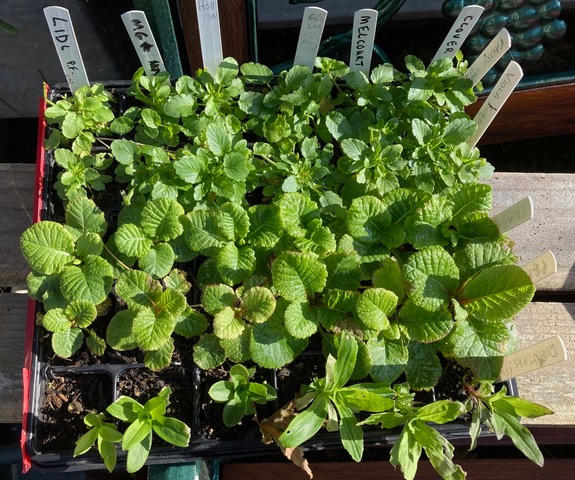
Tony planted 12 pansies, 12 primroses and 6 dianthus postiplugs in cells of the following mediums: Clover (peat), Sylvamix Nursery Stock Peat Free (PF), B&Q PF, New Horizon Multipurpose PF, Miracle Grow Premium Multipurpose PF and Lidl PF. After five weeks, there was little difference in growth rate and all of the pansies had flowered. The Lidl PF proved least effective, although being cheaper it can be used as a soil enricher, and two of Tony’s potted on Marigolds happened to like it best.
In another experiment, germinated Amaranth seeds did equally well in B&Q PF, home-made and Clover composts, with the other peat free varieties yielding only slightly less impressive results. Sungold tomato plants did well reaching 3.5m and producing 9 trusses each in Clover, B&Q PF, Miracle-Gro PF and home-made compost, and gave ripe tomatoes to the end of October outdoors.
With a fairly wide range of peat free options, Tony sought out a few industry experts for advice. Neil Williams, prize winning compost designer, of Petersfield Growing Mediums that deals solely with trade clients. Williams was of the opinion that Levington Advance Sustain Range is better than Melcourt (RHS-endorsed Melcourt Industries produces SylvaGrow® peat-free composts and selected mulches, topsoil and soil improvers.)
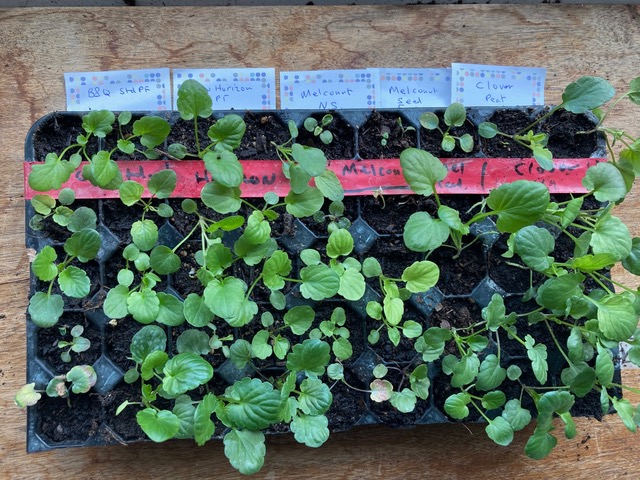 Following promising early results, more experimentation is underway to determine if more expensive peat free multipurpose composts perform well enough to justify their price, or whether seeds need to start in one media and then move to another to achieve optimal growth. Some gardeners are opting to start delicate seeds in peat-based, sieving out any lumps, before growing on in peat-free, though this is only a stop-gap before the eventual complete ban.
There is also the option of making your own compost, which may prove economical as prices rise in the new year. Composting our own food waste, leaf litter and windfall can create nutrient-rich material, virtually for free. The Natural Trust for Ireland offers a guide on Compost for Nature as a free download: https://www.antaisce.org/compost.
Here are some helpful tips when transitioning to peat free:
- It’s important to make sure your compost is fresh; the nutrient composition can change and controlled release fertiliser can leach out over time, so it is wise to buy only what you need for the season.
- Some seeds will react adversely to a nutrient rich starter compost, which may apply to some multi purpose media with additives.
- A propagator will provide additional warmth and supplementing early with an organic liquid feed can help seedlings that aren’t thriving.
- Peat free media may dry out faster but check this is not just on the surface. For small seeds, sieve out any lumps to help the seedlings take root and ensure proper moisture wicking
The key message is to not be put off by peat free composts, even when faced with one or two poor results. HIHS and the Trading Centre are on hand to provide advice and support and if we start to phase out peat composts early on, it won’t be as much of a shock when they’re suddenly off the market. Tony Athill is continuing his research over the next several months. Currently being trailed are Melcourt Seed, Melcourt Potting, Melcourt Silvergrow Multipurpose, Melcourt All-Purpose, Bulrush Multi-Purpose PF and Levingtons Advance Sustain PF comparing them against 2 peat based composts. He is testing these on various seeds.
Stay tuned for results.
Tony Athill
Links to additional info:
The need for peat bog restoration: https://www.irishexaminer.com/lifestyle/outdoors/arid-40854584.html
Opinion piece on ditching peat: https://www.irishtimes.com/life-and-style/peat-compost-is-a-con-ditch-it-for-the-real-stuff-and-enrich-your-life-1.4644643